Monday, September 24, 2007

Rudolph Giuliani's interrupting mobile

The debate around the proper use of mobile phones in different social situations has again manifested itself, this time through the actions of the former New York mayor Rudolph Giuliani during a speech to the NRA (September 21, 2007). In the midst of his speech he was interrupted by a mobile phone call, apparently from his wife, which he answered, dealt with, and then reflected on the dual positive/negative aspect of modern communications, that one can be contacted anywhere, anytime. The most curious thing about this event though, is whether or not it was an authentic interruption, or a staged performance.

One video on YouTube [ http://www.youtube.com/watch?v=NljO7w8fXKc ] discusses this very fact through a comparison with a previous speech, made in June this year (2007) to a different group (a Latino based-group). Both mobile phone interruptions occurred in the middle of the speech, and both featured the "I love you" comment to his wife. Whether or not this incident was authentic or not was not the issue for myself. Rather, what interested me was the performance aspect and the meaning-making (literacy) practices at play - authentic or not.

Let's assume first that the "surprise" calls were actually authentic, that they were really calls from a loving wife to her loving husband, whom she was not aware was in the middle of the speech. In contemporary post-industrial societies there is an emerging social expectation that there are times when it is appropriate, indeed, important, to switch off one's mobile phone. It seems to me that a formal speech to a group of constituents would be such a situation. In answering his mobile phone in the middle of his speech, this forms a moment where the "backstage" is brought to the front. This phenomena was observed by Leopoldina Fortunati observed on trains in Italy: when individuals spoke about private matters on a mobile phone in public, there was a sense in which the public persona of the person was changed by the emergence of their private lives - the "backstage" (2005). The fact that we only hear half of the conversation creates a further sense of mystery, in that something has been revealed, we are just unsure what. However, we might also call it an error in his "cultural literacy" (Shirato & Yell, 2000) practices: he has misread the situation as one where it is appropriate to answer a phone and have a personal conversation. Then again, he does keep the phone conversation short, to the point and indicates that he will call back. However, in such situations, what is indicated to an audience may be that the personal call is more important that all of the people in the audience. It is interesting to note than in NEITHER case did he appear to apologise to his audience for the interruption (although I have not seen the entirety of either speech). Does this imply that his actions were a natural part of this activity, to be tolerated, indeed accepted and applauded? In both cases he did receive applause for his candor and involved the audience either through reference, or in the first instance holding up the phone and encouraging the audience to say hello. One could surmise that this is one such way in which the social practices around 'mobile fields' are being negotiated and transformed: despite reworkings of traditional rules of etiquette suggesting you give your full attention to your audience in such situations, this public figure has sought to change the predictability of the practice of the public speech, which "...change over time as people engage in them in partially idiosyncratic ways." (Dimitriadis & Kamberelis, 2006, 67). Will we see further examples transforming the field of the public speech and the habitus of the public speaker, through the use of new technologies in the future?

In any case, if the incident was indeed accidental and unintentional, then there is an extend to which more is revealed of the humanness of the politician - he has a wife whom he loves and commitments beyond the scope of the presentation he is giving - which is perhaps one reason why there is speculation that this was a staged performance, intended to humanise this public figure.

If these 'unintentional' speech interruptions were actually staged, there is still an extent to which they are important and indicative of changes in the way we communicate and make-meaning. In terms of literacy practices involved, a whole raft of multimodal design strategies are in play. There is the fact that he takes the personal call loud enough, using aural design, ensures that the audience is involved in, and drawn into the conversation. His gestural design, or body language - despite dropping his head initially to answer the call - remains open and directed to the audience, suggesting that this conversation is for them as well as himself. He additionally reflects in the latter speech on the nature of this 'modern age' and it's technology. Thus the mobile phone call becomes yet another way for the politician to draw comparisons and similarities with the lived experiences of his audience: "See, I get phone calls at all sorts of strange times too! It can be bad and it can be good, but it is a part of the modern world that we share." In such a case the mobile technology serves as a form of symbolic communication (Katz & Sugiyama, 2006) or even symbolic capital (Bourdieu, 1977). In both these cases, the incident of mobile communication means more than simply taking a phone call: in the particular context of use, it takes on a range of connotations and meanings. The "I love you" line to his wife, repeated in the latter speech, obviously draws on a discourse of domesticity, drawing Giuliani as a caring and loving husband. The fact that the call arrives in the middle of a formal speech - apart from providing a ready-made audience for his gushing sentiments - also creates a performance of an imperfect human, prey to the inconsistencies and interruptions of daily life. The mobile phone in this case, becomes a tool of communication, to create discourse of humanness around the political figure. As a form of symbolic capital it may be surmised, mixed results are achieved. Whilst the place of a private mobile phone call in the midst of a formal presentation provides a catalyst for debate around 'mobile manners', in this case it is used to bring the "backstage" - or his private life - to the fore, to create a positive image of his domestic life (Fortunati, 2005). The most telling indicator of this is the loving and positive nature of the call. What a different image would have been put across if the call had been from his wife, berating him for something, or accusing him of being unfaithful. The symbolic value of the mobile phone in such a case would be far from positive.

Overall, the most curious thing about this event was simply the disruption of a traditional social practice by an individual's engagement with a mobile technology. Does this mean we are on the verge of witnessing a new wave of transgressions of traditional literacy inspired by social practices around mobile technologies. We have already seen this with the emergence of SMS - where traditional rules of written communication and grammar are transgressed and transformed in the emergence of a new written form. To what extent will social and literacy practices around mobile technologies continue to change other aspects of our literate lives?

Needless to say, in the wider media (e.g. morning news television) it has sparked debate and discussion about when and where it is appropriate to use mobile phones, and various other features of mobile technologies (SMS) and other technologies (email). This is of course one area that my current research with high school students seeks to examine.
References

Bourdieu, P. (1977). Outline of a theory of practice. Cambridge: Cambridge University Press.

Dimitriadis, G. & Kamberelis, G. (2006). Theory for Education. New York: Routledge.

Fortunati, L. (2005). "Mobile telephone and the presentation of self." In Ling, R. & Pedersen, P.E. (Eds.). Mobile communications: re-negotiation of the social sphere. London: Springer-Verlag, 203-218.

Katz, J.E. & Sugiyama, S. (2006). "Mobile phones as fashion statements: evidence from student surveys in the US and Japan." new media & society, 8(2), 321-337.

Schirato, T. & Yell, S. (2000). Communication and cultural literacy: an introduction. St Leonards, NSW: Allen & Unwin.

Labels: , , ,

Tuesday, July 17, 2007

Impact of Mobile Phone on Work/Life Balance - ANU Preliminary Report

Recently released preliminary findings from an Australian National University (ANU), AMTA/ARC study has supported the belief that the mobile phone is becoming an indispensable part of everyday life for the majority of Australians.
This large quantitative research project, reporting on findings from Phase 1 of the research, is based around a questionnaire, mobile phone log and 24 hour time diary. The result is a sample size of 1358 individuals from 845 households. Of this sample, the age-group that used mobile phones the most were aged between 18-39. Can we really have a moral panic about student use of mobile technologies in secondary schools, when many of their teachers use them even more frequently?
Some other interesting findings to come out of the research, even at this early stage, have to do with the factors influencing the individual's choice of 'different communication modalities'. These include why individuals use mobile phones as opposed to landlines, and why people send text messages instead of making a phone call.
When choosing a mobile phone over a landline, 'convenience' is the major influence, but when choosing and landline over a mobile, the major factor is 'cost' (Wajcman, et.al., 2007, 11). Making decisions between texting or calling are also related to financial, contextual, as well as intra- and interpersonal dimensions:
"The major reasons for sending text rather phoning someone were convenience, consideration for the other person's situation, and cost. Convenience is also an important consideration when deciding to use the mobile to phone someone rather than sending a text but the main reason is how important or time critical the topic is. " (11)
It is refreshing to see some research into the effect of contextual factors on the modalities of contextual practices.
There was also some interesting preliminary findings on how people use their mobile technologies, focusing on what features they use. The vast majority of uses were for talking and texting, though there was still other uses emerging around using the visual (photos), voting, Internet and music functions of phones (around 20% each). It would be further interesting to see how contextual factors (such as those for choices between landlines, mobiles and texting) influence choices around these other modes of semiotic engagement.
This research is laying important new ground in scholarship about mobile technologies and their effects on the everyday social lives of Australians. It provides a statistical backdrop for more detailed ethnographic or case-study based investigations that can flesh out the lived experiences of people as expressed in the findings of this research.
I will remain interested in how this research progresses, it's further findings and how they may tie in with and inform my own studies.
The full preliminary report is available through the ANU website at the following URL:
References
Wajcman, J., Bittman, M., Jones, P., Johnstone, L. & Brown, J. (2007). The Impact of the Mobile Phone on Work/Life Balance: Preliminary Report. Australian Mobile Telecommunications Association and Australia National University. Retrieved on 17 July, 2007 from: http://polsc.anu.edu.au/staff/wajcman/pubs/Report_on_Mobiles_and_Work_Life_Balance_June_07.pdf
Walliker, A. (July 17, 2007). Mobiles change world. Herald Sun, p.7.

Labels: , , , , ,

Thursday, January 11, 2007

Response to iPhone Release

With the release of the new iPhone yesterday (Jan, '07), I have been given cause to reflect about impacts on techno-literacy practices, due to its revolutionary new interface. Not only does it look really cool - sleek, uncomplicated - (on that basis alone I have decided that I WANT ONE!) but the interface is so different from all that has gone before it, that as stated in the media: "...the iPhone appears poised to revolutionise the way mobile phones are designed and sold." (The Age, Jan 10)

The first thing that I thought about when I saw the new design was how the input method was more like a computer than a mobile phone. Now I havn't used a Mac extensively since high school (at least 1995), but remember how menus were accessed, drag-and-drop features, and 'windows' well before I ever logged onto a PC. Features such as the ability to use a QWERTY keyboard, access internet sites and zoom in, listen to music and watch videos, send email and SMS, all point to this 'phone' being more of a mini-computer than a mobile phone, a shift in thinking that Marc Prensky has been calling for for a number of years (Prensky, 2004). When watching footage of the iPhone release, this was one of the features that struck me.

Another feature of the iPhone that seems really fresh is the fact that menus and features are accessed through an 'icon' interface. Whilst this feature has been common on many smartphones for a number of years, one still had to use the keypad or navigation buttons to scroll through and make selections. It is here, with the touch screen that the truely ground-breaking innovation of the iPhone comes into its own. The 'dislocation' between accessing phone features through clicking keys that correspond to a selection on the screen, is substantially diminished by being able to simply point to what you want on the screen itself. It seems to be a difference like that between handwriting and typing; which feels more human and 'tactile'?

I even found a website/blog where possible designs for the upcoming iPhone were displayed (http://appleiphone.blogspot.com/). It is interesting to note how a lot of the predictions subscribed to typical mobile phone or iPod design features (including keypads, navagation wheels, etc). And then there are some just plain 'far-out' designs. It is interesting to note though, that the touch-screen nature of the iPhone moves it dramatically away from previous model smartphones, making it closer to a PDA that you accessed with one of those 'stylus-pen' things. But here you get to just use your finger - point at what you want and it supposedly happens. I suppose it still remains to be seen what kinds of difficulties this touch screen producers

It also remains to be seen what effect this new design will have on individual dispositions with regard to communication. How will the 'apparant' easy of use of the iPhone influence dispositions towards modal selection for semiotically based activities? This is the area that really interests me. I have no doubt that the iPhone will take off extremely quickly - there is already the ready-made iPod market who will jump at this new device as a kind of 'up-grade' - but there will also be a large proportion of individuals that will be attracted to the iPhone due to its innovative design and features (not to mention the 'huge' screen size by comparison to other model phones!).

The effect of this interface design on the choices people make about everyday literacy events involved in communication and information retrieval/dissemination is of course a completely untested and unknown area. Sure, reading pathways will be somewhat limited (as with all phones) by those linkages laid down in the design of the product, however the ability of this device to access a wide range of internet sites opens up the possibilities for hypertext practices on the move in a very real manner. How will this ability to access a wide range of information sources at 'anytime' (take this idea with a pinch of salt of course) influence the decisions we make in everyday practice?

Will the apparent ease-of-use of the new interface have an impact on dispositions towards communication modes when using the iPhone? With the ability to use a QWERTY keyboard change the nature of SMS? Will the ability to send emails as easily spell the death of SMS to some extent? Will there be an impact on our dispositions towards making a phone call as opposed to 'txting' someone? Will the larger screen result in more extensive 'txt' messages or an increase in MMSing?

If the iPhone is taken up with as much enthusiasm as the iPod, what will be the results for the rest of the mobile phone market? With this device acting more like a mini-computer and presenting a functional convergence of technologies, a new expectation has just been set for the mobile technology market generally! I can't wait to see the response of other companies like Samsung, Sony-Ericsson, Motorola, etc., just as they responded to the iPod with their own portable music and media players. It is curious that Apple has called it an 'iPhone', when clearly the 'phone' is just one feature of many. The need to reconceptualise what we mean by a mobile phone or cellphone (or whatever other term is used), is clearly demonstrated with this new release.

It may be cliche to say: but the iPhone has set a new bar for mobile technology design, in terms of features, interface and design. The impact of these technologies on the literate practices of individuals in their everyday lives is of course yet to be seen or tested (in fact, the same could be said for most mobile technologies today in any case). I for one, am excited by this new release, this new innovation. Watching the impact across society and individuals should prove a far more interesting show than anything you could download and watch on it.


References

"Apple looks to reinvent itself." (2007, January 10) The Age.
Accessed on 11 January, 2007 from: http://www.theage.com.au/news/biztech/apple-looks-to-reinvent-itself/2007/01/10/1168105032307.html

Prensky, M. (2004). "What can you learn from a cell phone? - Almost anything!" Innovate!, 1(5). Accessed on 11 January, 2007 from: www.marcprensky.com/writing/

Vardarova, O. (2004). "iPhone Concept Blog." Retrieved 11 January, 2007 from: http://appleiphone.blogspot.com/

Labels: , , , ,

Thursday, November 09, 2006

The Loaded Decision of Coverage

I find myself once again, and quite unintentionally, caught up in the maelstrom of mobile phone selection. I received a phone call from my mobile communications service provider - who shall remain nameless - informing me that because I had been with them for so long (at least 7 years), they would be rewarding me: free credit on my next recharge (I still use pre-pay) and a free, new handset. I could even get a free 3G handset!

Now, after the fuzzy feeling of being appreciated by some faceless corporation wore off, I began to once again appreciate the complexity and difficulty in selecting a mobile phone. I had forgotten this area of complexity. It must appear that much more difficult in the US, where phone service provider choice can in some ways be even more determining of the people and technologies you have access to. I had been going along with the assumption that a lot of people had mobile phones which they simply used, and in such exercised literacy skills. I had overlooked the intricate set of negotiations and understandings involved in the consumer's engagement with the market in selecting a mobile phone and a service provider; along with the inherently political nature of this engagement. In essence, choosing a mobile phone - such a ubiquitous and important part of contemporary everyday life for many people - is no simple task in contemporary Australia.

My situation is additionally, not as complex as most in that I am sticking with the same service provider (I am getting sick of this term! - what others can I use?) as they're the ones giving me the new mobile phone! Therefore I am really choosing between different model mobile phones (an easy task of choosing what you like the most - I like flip-phones), but more importantly, whether to choose a 3G model, and joint the 'Third Generation' network. This is the more complicated decision, as the network you choose, determines the coverage that you receive.

Mobile phone coverage was a contentious issue of debate during the roll-out of mobile phones into popular Australian culture during the 1990s. This was especially evident in a binary discourse that emerged regarding equality of access between urban/rural Australians, a binary that still exists to some extent. You can still travel through many areas of rural Australia and, depending on your coverage provider, may find yourself out of 'contact'. This situation is improving continually, though still exists. I know that my own provider drops out of coverage between towns in Northern Victoria. This is even more evident with the 3G network, which is not rolled out and available through most of rural Australia. If I make the decision to buy a 3G phone, to learn about all these new features available, then I forgoe access to that whenever I got to rural areas to visit family and friends, or for work of course.

Third Generation Networks have expanded recently with Telstra (the largest provider in Australia) launching it's 'NextGen' Network. This is a third generation model, which builds on Telstra having the most extensive coverage in Australia. It will be interesting to see if this allows for the expansion of other 3G networks provided by other corporations. If so, my decision of whether to choose a 3G phone would not necessarily limit my access in rural areas. But then again, there are still areas that don't have any digital coverage! We've all seen the skit on various television shows and movies of someone moving their mobile phone about in order to find better coverage; in rural Australia finding better coverage may generally involved a more extensive drive in the car.

The difficulties of roaming between different countries is of course even more pronounced and plagued with the difficulties of traversing different networks (unless your provider has a form of 'roaming' which is covered).

I was quite comfortable with my 2-year-old mobile phone. Sure, I haven't figured out all the features and how to access everything available with it yet, indeed, I don't use most of the features, but the offer of a new, free handset is always a temptation for one raised in consumer culture. One phone call has once again set my mind off into that labyrinth of deals and contracts and features and coverage and all the rest of that nonsense, which in some ways form legally binding contracts. There are regular media stories of young people (and wider-people generally) falling victim to the financial dragon of mobile phone contracts, or developing 'negative social habits' as a result of phone use (but these are issues for discussion at another time).

Choosing a mobile phone is a social task fraught with complexity and difficulty. Despite the image portrayed in marketing of easy of choice and easy of access, buying such a constantly used and financially alive device, is not the same as buying shoes. Like everyone else, I will continue to navigate my way through this briar-patch of possibilities and the restrictions and possibilities they allow for my communicative practices.

Labels: , , ,

Saturday, September 30, 2006

The Extremes of Mobile Phone Commodification


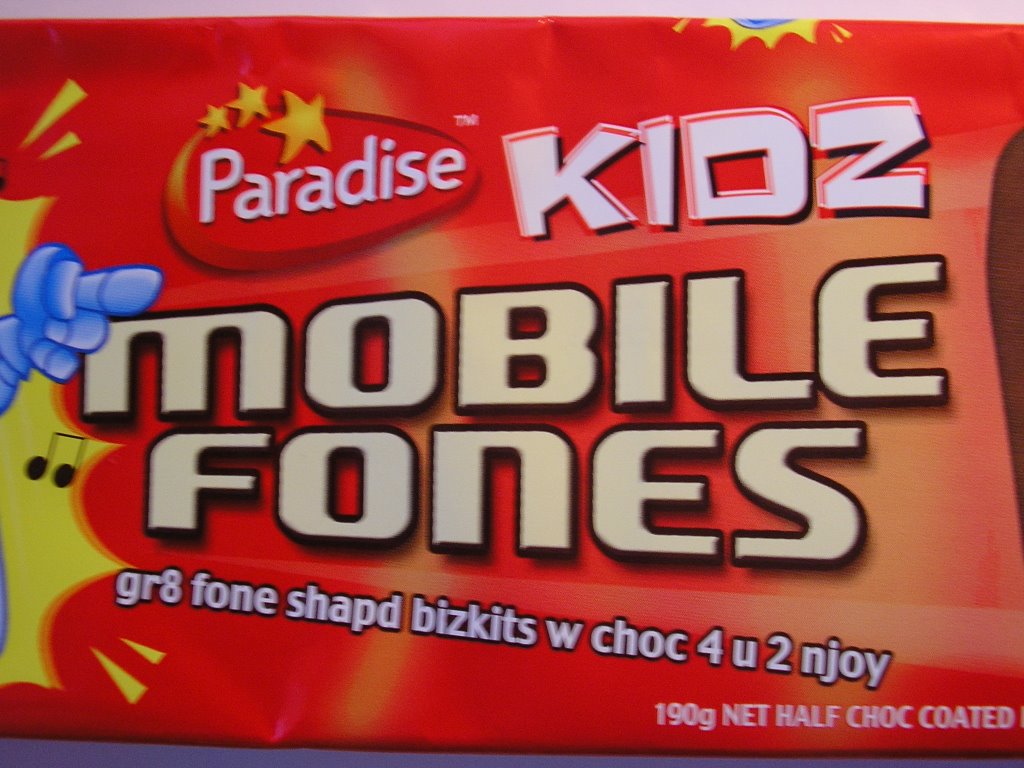
I literally had to rub my eyes when I saw this packet of biscuits at my local supermarket; then I just had to have them!

So I purchased a pack of Paradise Foods "Mobile Fones" chocolate biscuits.

What a fantastic cultural artifact this turned out to be, demonstrating the extent to which mobile phones, aside from any functionality or purpose, have become commodified by market forces. I do not know in what other countries - if any - these biscuits are available. What was most interesting to me, aside from the fact that they appeared to have picked mobile phones as the topic of their biscuits for no logical reason (save economic or marketing studies no doubt), but they manner in which semiotics are deployed on the packaging - the second skin of commodification.

Clearly the consumer group whom is target by this product is children, and in a much more direct manner than through parents. The language deployed on the packaging - including 'squeeze-text' or 'txt' (Carrington, 2005) or 'acronymy' (Bodomo & Lee, 2002), along with personification of the mobile phone itself, is clearly aimed at a younger audience; those whom are tech and mobile savvy.

The first thing that I immediately noticed, apart from the bright colours and picture of a happy, smiling mobile phone on the packet, was the sub-title to the product name, curiously written the the abbreviated language of SMS.
"gr8 fone shapd bizkits w choc 4 u 2 njoy"
Whilst this message is fairly straight forward, even for those relatively uninitiated in the language of SMS, it is a fairly clear appeal to a particular audience. The designers of this product - the packaging in particular - have intentionally deployed a language form generally associated with younger, more tech-savvy 'digital natives' (Prensky, Don't Bother Me Mum - I'm Learning! 2006). This is part of a clear attempt to relate to the consumer on the basis of identity and group association, through a use of their own language, as opposed to the expected language of 'the establishment'. By speaking to young people on their level, using their language, the marketers are clearly acting in a manipulative manner that is not all that unexpected in modern consumer-media culture.

The second point which I found most interesting about this cultural artifact, was the manner in which the technology of the mobile phone was acquired and commodified as a mascot for Paradise Foods through the persona of "Moby".

The first encounter that the consumer has with Moby is encountering his smiling face on the front of the packet. There is nothing new about this marketing ploy of course: smiling faces and images that engender feelings of happiness have been an overbearing feature of the commercial sector since the development of its modern manifestation in the twentieth century. The reduction of the mobile phone as a technology to a mere character is an interesting way in which mobile telephony generally seems to be being normalized in this cultural artifact. The further description of Moby on the back of the packet, adds further depth to his character, but also reveals a more disturbing aspect to this commodity: its intended audience.

I have already suggested that in deploying SMS language, this cultural artifact is clearly allying itself with youth culture through their lens of language. Turning to the Moby profile reveals more about the intended consumer of this product:

"Meet Moby
Moby is a cool little dude choc-full of playful energy. He just loves to keep on the move, getting connected with his mates and having fun along the way. Paradise Kidz Mobile Fones have a great chocolate taste and are fun to share wherever you may be.
www.paradise4kidz.com.au "

I know that when I first read this small outline I could not get over the connotations drawn with being mobile and connected("...keep on the move...wherever you may be..."), friendship ("...with his mates...") and play/fun ("...playful energy...having fun...fun to share..."), and how this is cleverly linked in with the qualities of the product. Not only is the language clearly directed at a young audience - pre-teen - but once again, there is the suggestion of a shared cultural identity with their audience.

Clearly, Paradise Foods, as indicated by their website, is engaged in a process of constructing a culture around their products, based very much on appealing to the interests, identities and affiliations of young people. I also wonder who notices the website for paradise foods on the back of the packet and goes to it: kids? Parents? It does seem highly superficial to conscript a seemingly innocuous device such as a mobile phone to advertise a packet of chocolate biscuits, but this is not a new phenomenon by far. Consider the relevance of some well-known brand icons to their actual product: Coco Pops, Rice Bubbles, Fruit Loops. Additionally consider the manner in which popular cultural icons, such as movie and television show characters are co-opted for marketing purposes: McDonalds' happy meals are the ideal example of this (featuring regular toys from the latest release movies, or other fad). In this context, the move to have mobile phone biscuits is not that strange at all.

But it it strange in another way: introducing children to technologies in the form of play, yet technologies which essentially have an economic dimension. It is a curious irony that whilst the marketing around the mobile phone in this context is based on fun and freedom, the economic aspect of purchasing the biscuits, or a real phone, is something that can impinge upon that fun and freedom: what happens when mum says no, she will not buy the biscuits for the kid?

Here we have a true indication of the manner in which mobile phones have become an accepted and at times, invisible part of our everyday lives. Just as Davide, Dario and Tal revel in their "Fashion Victims" research, by "...Subverting the everyday behaviour of an everyday object..." Can change the light in which we see a cultural artifact. In this case, the nature of the mobile phone as a cultural artifact is revealed: one that is linked with young people, fun, freedom and friendship.

I wonder how mobile phones will manifest themselves throughout consumer-media culture as they become even more ubiquitous.

Labels: , , , ,